

What is solution cathode glow discharge (SCGD)?
SCGD is the atomic emission technique inside every AquaValid: the water sample itself sustains a low-power micro-plasma, and the metals in it emit light at their characteristic wavelengths — the same optical-emission physics trusted in laboratory analysis, without the laboratory.
How an SCGD measurement works
1 · Flow
The sample stream flows continuously through the analyzer — no bottles, no batch prep.
2 · Ignite
A low-power discharge forms a micro-plasma directly at the surface of the flowing sample.
3 · Emit
Metal atoms emit light at wavelengths unique to each element — lithium’s signature is not copper’s.
4 · Read
An onboard spectrometer reads the emission and reports concentrations about a minute after sampling.
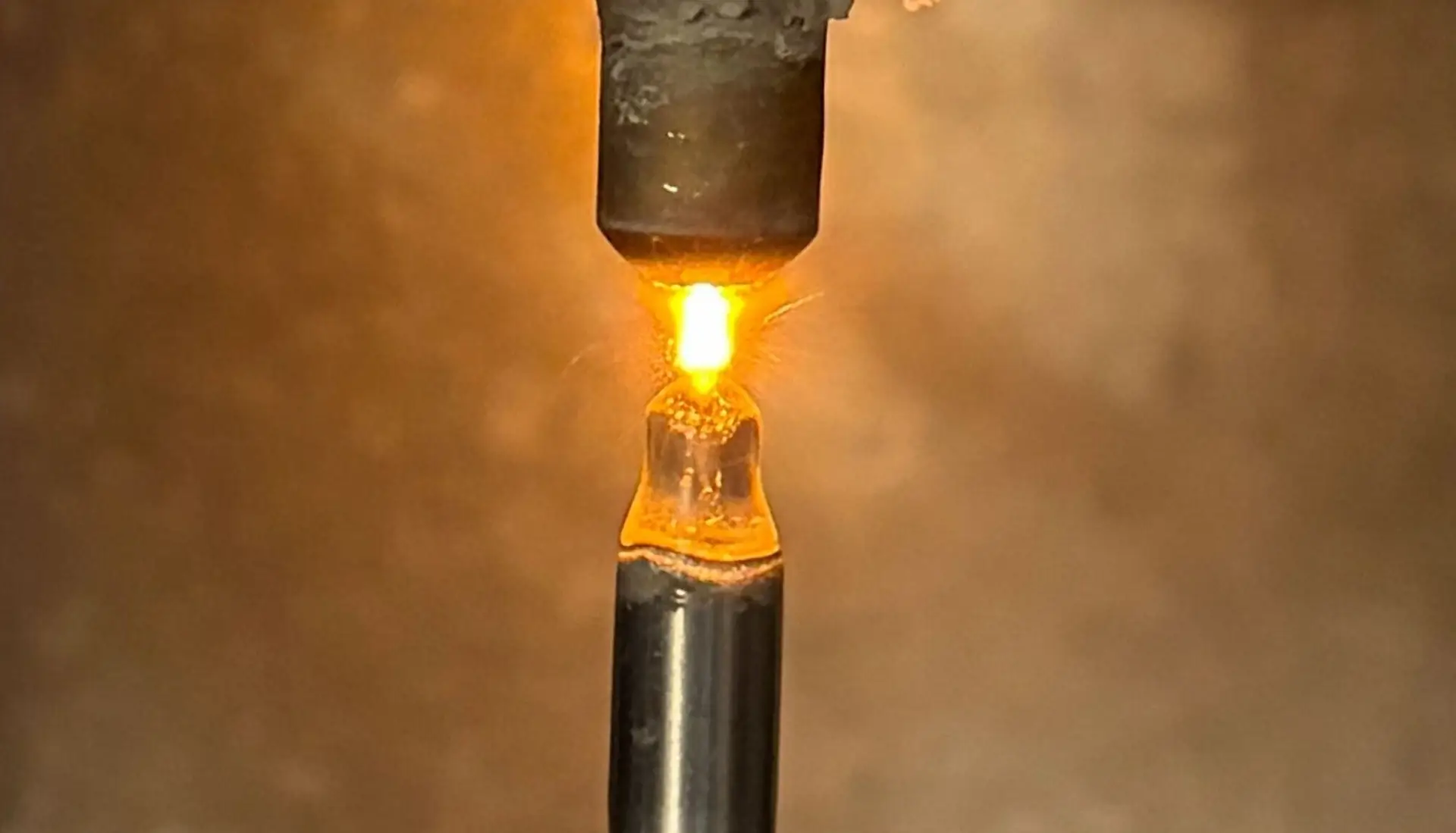
Lab-grade physics, without the lab machinery
Laboratory optical emission systems earn their accuracy with infrastructure: argon supply, vacuum interfaces, plasma torches, trained operators. SCGD delivers the same class of physics in a package that lives in your process line:
- No argon supply — the plasma is sustained at atmospheric pressure by the sample itself.
- No vacuum interface, no plasma torch — dramatically less to maintain, power, and break.
- One reagent — a plasma conditioner, plus onboard calibration standards and deionized water.
- Fully automated — sampling, measurement, calibration, and self-cleaning, unattended.
Independently examined
Validated against ICP
Designed as a complementary layer: ICP answers “what is defensible?”, AquaValid answers “what is happening now?”
InnoTech Alberta
Independently validated an SCGD analyzer for water quality monitoring, confirming Ca and Mg performance against ICP reference analysis (2024).
Peer-reviewed
A 2026 study (J. Anal. At. Spectrom.) found SCGD agrees with ICP-OES within 5–9% for Ca, Fe, Zn in complex water matrices.
The peer-reviewed study was not conducted in mine process water — as with every deployment, site-specific validation on a sample of your actual water comes first.
SCGD FAQ
Is SCGD as accurate as ICP?
SCGD delivers lab-grade optical-emission measurement, validated against ICP. They answer different questions: accredited ICP builds your defensible record; SCGD tells you what your water is doing continuously, between those samples.
Why doesn’t it need argon or a plasma torch?
In SCGD the flowing water sample itself acts as the cathode that sustains the plasma at atmospheric pressure — so the consumables and hardware that make laboratory plasmas expensive to run aren’t part of the design.
What maintains the calibration?
The unit carries its own custom calibration standards and deionized water onboard, and recalibrates automatically — no field technician, no lab visits.
Tell us about your water
We’ll tell you honestly whether AquaValid can see what you need.
Contact us